What is the primary operational weakness of legacy touch-tone IVR systems?
Rigid DTMF menu trees ("Press 1 for sales, Press 3 for billing") force callers into frustrating loops, leading to high call abandonment and customer dissatisfaction.
Editorial review
This article is reviewed by the Yanitly editorial team for product accuracy, privacy and security claims, and integration references. Technical claims are kept aligned with official documentation or observed Yanitly product behavior.
Updated: 2026-09-18
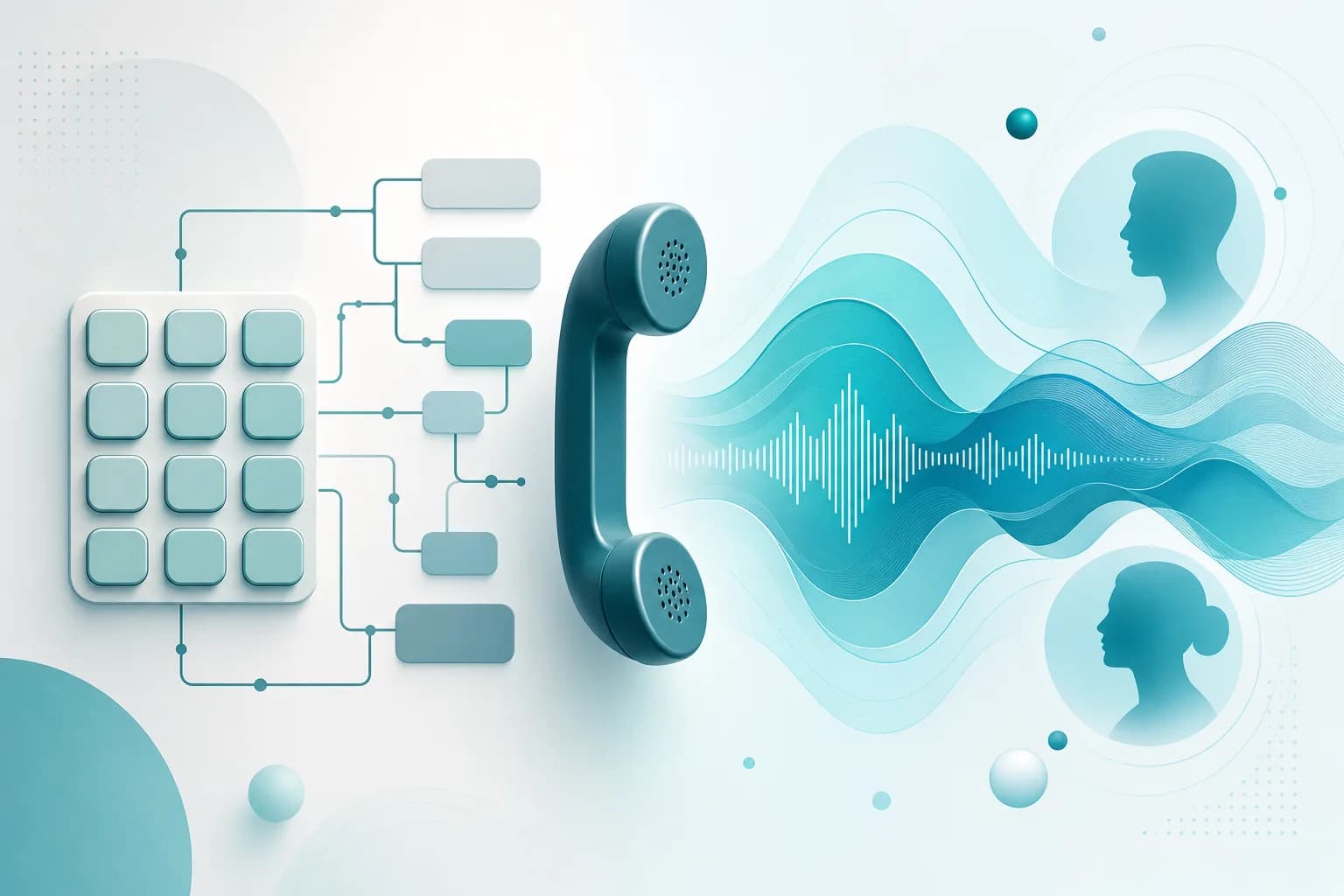
For decades, legacy touch-tone Interactive Voice Response (IVR) systems have dominated enterprise telephony, yet they fall drastically short of contemporary customer service expectations. Forcing callers to navigate numeric menus—"Press 1 for sales, Press 2 for technical support, Press 3 for billing"—induces frustration when callers cannot locate their specific issue, driving them to mash buttons to reach a human operator. Thanks to breakthroughs in conversational voice artificial intelligence, telephony operations have transformed. Next-generation voice agents like Yanitly Voice Live listen to callers naturally without menu mazes, resolving complex inquiries like a seasoned professional.
The distinction between legacy touch-tone IVR and conversational AI voice agents is not merely an incremental software patch; it represents an entirely different operational paradigm. On one side sits a rigid, mechanical decision tree; on the other stands an intelligent digital representative endowed with contextual reasoning, institutional memory, and live transactional capability.
Conventional IVR architectures suffer from fundamental operational liabilities:
These constraints overburden human support teams with high volumes of repetitive, low-value inquiries.
Modern voice AI agents synthesize automatic speech recognition (ASR), large language models (LLM), and neural text-to-speech (TTS) into a unified, low-latency conversational pipeline:
When a caller states an intricate sentence: "I purchased an office chair last Tuesday and need to change the delivery address before it ships tomorrow", the platform resolves the request fluidly:
In legacy systems, a recorded prompt plays mechanically until finished, ignoring caller input. In conversational voice AI, if a caller interrupts: "Understood, but are you open on Saturday?", the speech engine yields instantly to address the new question.
Evaluating key capabilities reveals decisive contrasts:
Transitioning to conversational voice AI does not require replacing existing telecommunications investments. Yanitly Voice Live:
Enterprises replacing legacy IVR trees with conversational voice agents realize immediate returns:
Conversational voice AI liberates customer telephony from outdated menu trees, establishing the modern standard for enterprise communications.
A voice AI assistant that answers phone calls, books appointments, replies to common questions and connects transcripts and analytics to Yanitly.
Netgsm and enterprise SIP trunking, Asterisk 22 PBX architecture, 100+ concurrent calls, sub-500ms latency tuning, and legacy IVR modernization.
Rigid DTMF menu trees ("Press 1 for sales, Press 3 for billing") force callers into frustrating loops, leading to high call abandonment and customer dissatisfaction.
They utilize real-time speech-to-intent models that parse unstructured sentences, emotional tone, and contextual requests in sub-second latency.
Yes, they interface seamlessly with Asterisk, FreePBX, Cisco, and cloud telephony platforms using standard SIP trunking and RTP streaming.
By resolving routine inquiries end-to-end without agent intervention, they reduce contact center operational overhead while raising representative productivity.